Grouting & repair
Non-shrink grout for machine bases & anchor bolts
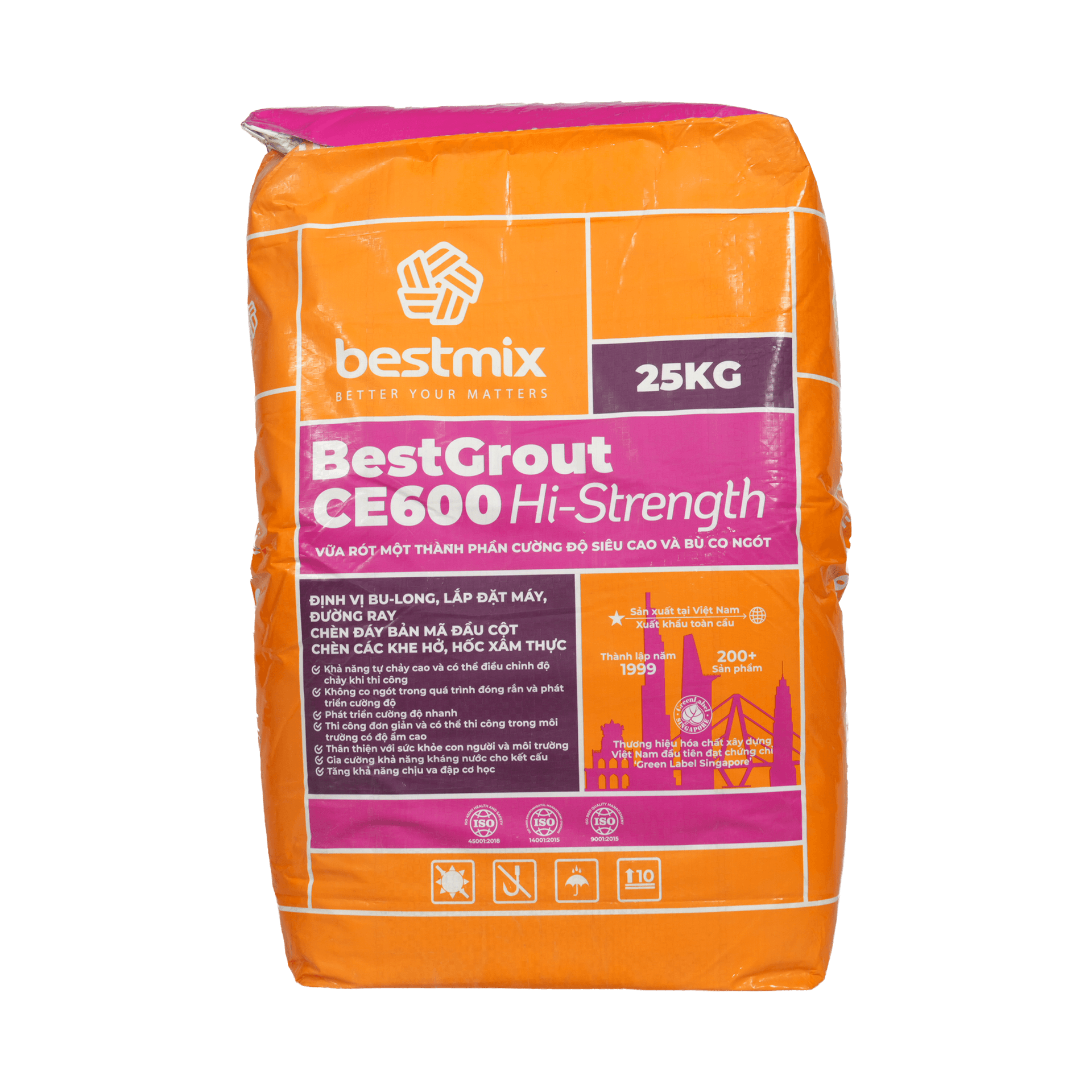
BestGrout CE600 is a pre-blended one-component grout: self-levelling, self-compacting, high-strength and non-shrink, made from improved cement, silicate minerals and special admixtures.
Public technical guidance
This page is selection and sequencing guidance, not a project method statement. The current product TDS, approved design, site assessment and trial application take precedence; structural anchors, cracks, water-retaining structures and other safety-critical work require qualified technical review.
Applicable for
- Bolt positioning, machine foundation installation
- Rail bed installation
- Filling under column base plates
- Wide gaps, large voids, spalled pockets
- Special precast members, bridge pier connections
Substrate requirements
- Clean, sound and oil-free concrete; roughen for bond, saturate before grouting and remove all standing water
- Minimum grout gap 8 mm; verify thickness, geometry and venting against the design
- Clean metal contact surfaces back to sound metal where bond is required
- Watertight, firmly fixed formwork with suitable pour head and vent path; seal every gap
Step-by-step procedure
- 1
Mix
Measure water at 12–14% of powder weight, add powder slowly to the water and mix at low speed until uniform. Under the 2025 TDS, BestGrout CE600 must be placed within about 15 minutes of mixing; do not remix or add water after setting begins.
- 2
Place (pour/pump)
Pour or pump continuously from ONE side to keep pressure, avoiding entrapped air and layering. Do not vibrate. A stiff wire loop moved back and forth helps release air. Place as fast as possible (ideally < 15 min after mixing). After setting, cut a 45° chamfer from the base plate to prevent edge cracking.
- 3
Cure
Cure immediately with water / damp hessian / plastic sheet to prevent drying and surface cracking; avoid direct sun and harsh weather; strip formwork only after the grout has set.
About 1.9 kg dry powder per litre of mixed grout. For thicknesses over 60 mm, add 50–100% clean, selected coarse aggregate only after trials; mixing water remains no more than 14% of powder weight.
Common questions
What is non-shrink grout used for?
To fill load-transferring gaps while limiting shrinkage: machine bases, steel column base plates, anchor bolts, bridge piers, void repair.
Can water be added for more flow?
No. The TDS mixing-water range is 12–14% of powder weight; exceeding it can cause bleeding, lower strength and increase shrinkage risk.
Why pour continuously from one side?
Continuous one-side pouring maintains pressure, pushes air out and avoids entrapped air/layering — ensuring full contact with the form base.
Need advice for your project?
Bestmix engineers help you choose the right system and consumption — free of charge.